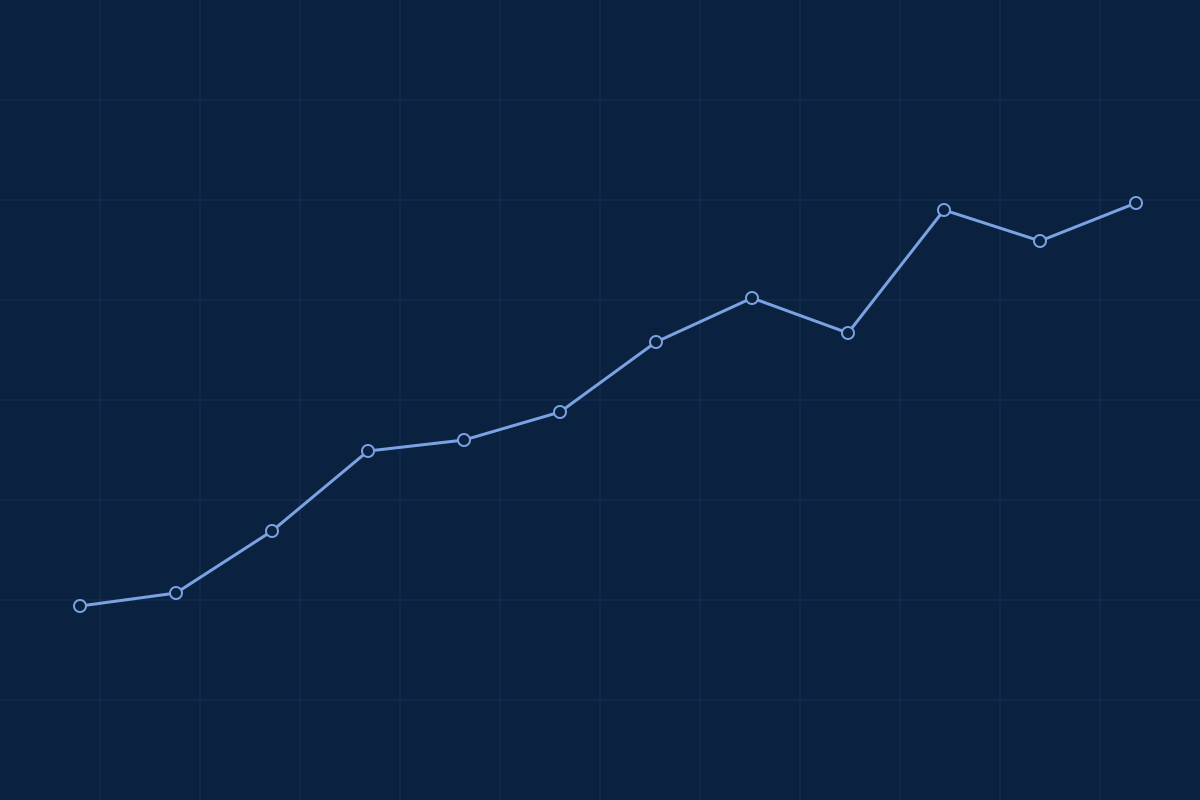
Why Productivity Growth Has Become So Difficult
Output per hour has grown more slowly across the advanced economies since the mid-2000s. Economists agree on the pattern and disagree on almost everything else.
Productivity is the closest thing economics has to a master variable. Over a long enough horizon, almost everything a society can afford — wages, pensions, public services, the capacity to absorb a shock — depends on how much output it gets from an hour of work. Which is why the slowdown across advanced economies since the mid-2000s is the most consequential economic fact of the last two decades, and why the disagreement about its causes matters so much.
The accounting is easy. The explanation is not.
Start with the standard decomposition. Output depends on capital, labour, and the efficiency with which they are combined:
$$Y = A \cdot K^{\alpha} L^{1-\alpha}$$
Measured growth in $Y$ that cannot be explained by growth in capital $K$ or labour $L$ is attributed to $A$ — total factor productivity. The trouble is that $A$ is a residual. It is defined by what it is not, which makes it a measure of our ignorance as much as a measure of technology.[1]
Four explanations, none sufficient alone
| Explanation | Core claim | Weakest point |
|---|---|---|
| Mismeasurement | Digital output is undercounted | Slowdown appears in sectors with good price data |
| Diffusion lag | Gains concentrate in frontier firms | Does not explain frontier slowdown itself |
| Low investment | Weak capital deepening post-2008 | Predates the financial crisis |
| Ideas are harder | Research productivity is falling | Difficult to test directly |
The residual is a measure of our ignorance. Naming it "technology" does not make it an explanation.
What follows for policy
The honest position is that each explanation carries some weight and none carries all of it. That matters, because the policy implications diverge sharply. If the problem is diffusion, the answer is competition policy and management capability. If it is investment, the answer is the cost of capital and planning. If ideas are simply getting harder to find, the answer is more research funding for a smaller expected return — a much less comfortable conclusion.
What should not survive contact with the evidence is the confident single-cause story. Anyone who tells you they know which of the four is doing the work is telling you about their priors, not the data.
This is Abramovitz's famous description of the residual, and it remains the honest way to read any TFP series. ↩︎
References
- Illustrative figures only — replace with sourced data before publication.
- Solow, R. (1957). 'Technical Change and the Aggregate Production Function.' Review of Economics and Statistics.