The race to keep Europe's unicorns
EU Inc could be the moment Europe stops exporting its best ideas and starts backing them.
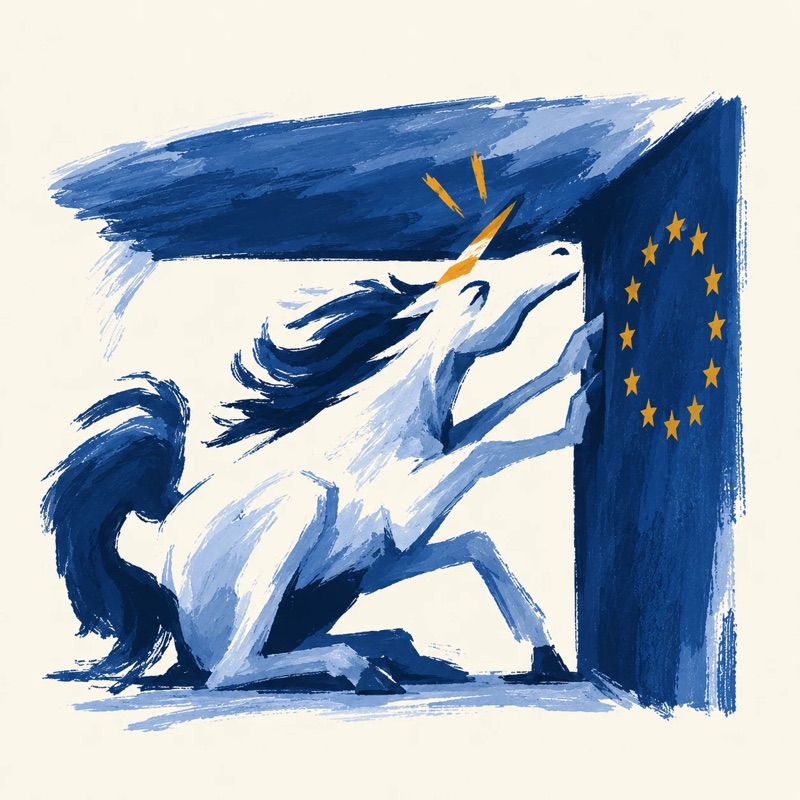
Two years ago, Mario Draghi's report on competitiveness showed how Europe loses its start-ups to the United States. Europe has not grown a single company from scratch to a valuation above €100bn in the last 50 years. In the same period, the US has created six companies worth more than €1tn. Adding insult to injury, between 2008 and 2021 close to 30% of the unicorns founded in Europe (companies worth more than $1bn) moved their headquarters abroad, most of them to America.
The report found that a patchwork of national rules and European bureaucracy was sending start-ups across the Atlantic. It was not just that American money dwarfed European money. It was simplicity. American investors want a single, simple company form they already understand, and Europe had 27.
The European Commission's answer is EU Inc. The proposal would let founders set up a company for under €100 in 48 hours. The rules would be identical across the bloc: one company form, the same in every member state.
EU Inc has already met pushback. Trade unions wanted it restricted to start-ups rather than open to all companies; René Repasi, the European Parliament's lead negotiator, has refused. Governments are working through draft texts under the Irish presidency of the Council, and the latest draft keeps common stock option rules only for firms with fewer than 1,000 staff and under €450m in turnover.
Stock options matter because start-ups hire people they cannot afford to pay. Instead, they offer a smaller salary now and a slice of the company, which may turn out to be worth a fortune if (a big if) the company succeeds. But in some EU countries, staff are taxed on the paper value of their options before they have sold a single share. EU Inc would shield these options across the EU, up to the threshold of 1,000 staff and €450m turnover.
The threshold spares almost every young firm. The trouble is that investors in early rounds are betting these companies will grow far past it. Above the ceiling, companies would fall back on the same patchwork of national rules the initiative is designed to escape. Stéphane Séjourné, the commissioner in charge, has told ministers that much of EU Inc's appeal disappears without common stock option rules.
The unions' worries are fair. They fear that larger firms would skimp on proper wages and hand out stock options instead, registering in whichever member state has the weakest rules. But addressing this does not require a size cap. Ireland's latest note to governments already says the scheme cannot touch minimum wages or pay set by collective agreements, and checks on where a company really operates would deal with the rest. Both fears can be met without punishing firms for growing.
To its credit, the EU is moving quickly. EU Inc was proposed in March, and a deal is targeted for December. The Commission is urging governments not to water the plan down. Keeping up that momentum is critical if Europe is not to fall further behind.
References
- Mario Draghi, The Future of European Competitiveness, European Commission, September 2024.
- Science|Business, Parliament draft report adds EU Inc safeguards to prevent fraud and regime shopping, 2 July 2026.
- Trending Topics, EU Inc: start-ups, notaries and unions clash in lobby meetings, 6 October 2026.
- Trending Topics, EU Inc open letter, 15 October 2026.