Winds of Change in Europe
Canada has been offered a seat at Europe’s table; Britain is still in the dog house. A cornered German chancellor needs Europe to look like it’s winning, and Burnham can give him the proof.
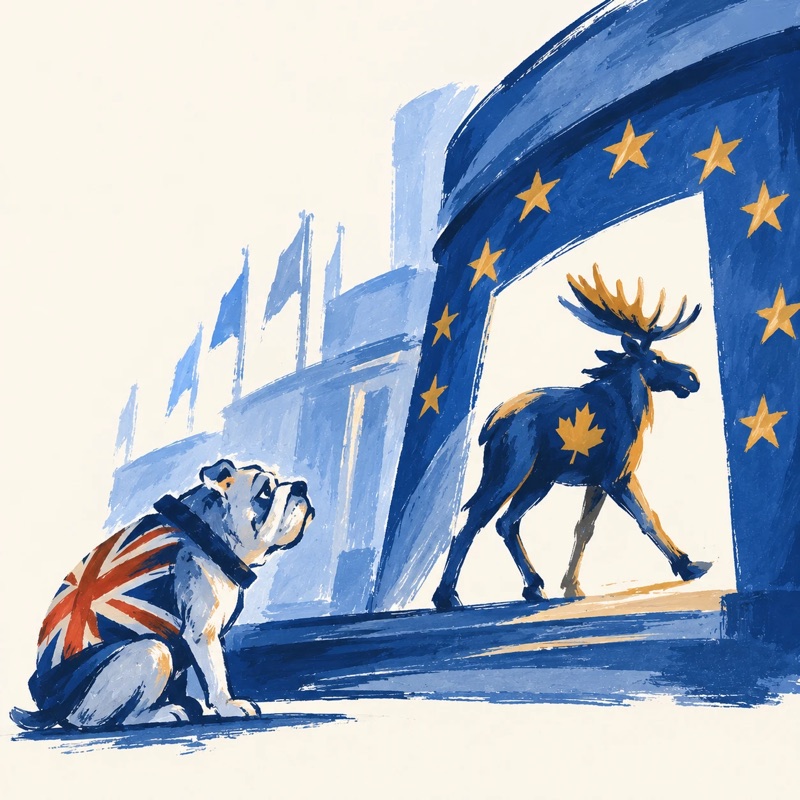
On the 16th of September, in Strasbourg, Ursula von der Leyen told MEPs that she would work with Carney for Canada to become the EU’s first associate member. On paper, the EU is adopting the argument Carney made at Davos in January. Canada managed this while never having been part of the European project and being 3,000 miles away. Britain spent 47 years inside the EU and is 20 miles from its coast.
The offer of associate membership to Canada is telling of a redrawing of the European position in the world, a ways away from the Europe David Frost was negotiating with on behalf of Boris Johnson.
Canada has already joined SAFE, the EU’s €150bn fund for collective rearmament. If the UK doesn’t take some initiative, Ottawa will be closer to Brussels than London.
What makes this moment different is Germany. Friedrich Merz has had a September to forget. On the 6th of September, the AfD won 43.8% in Saxony-Anhalt, putting it within reach of power in its own regional parliament. Two weeks later, the CDU failed to clear the 5% floor to get a single seat in the Mecklenburg-Vorpommern parliament. In Berlin, where the AfD is persona non grata, Die Linke, the far-left party, won. The fallout was such that Merz cancelled his trip to the UN General Assembly in New York.
Merz is backed into a corner; if the AfD comes to power, they have pledged to take Germany out of the euro, Schengen (the EU’s passport-free travel area), and have toyed with the idea of leaving the EU entirely. Not to mention sanctions being lifted on Russia.
Meanwhile, Die Linke opposes Russia but also opposes military aid to Ukraine, opposing the €800bn plan to rearm the EU, the plan that pays for SAFE. The two parties claim to be diametrically opposed, yet they push back against Merz’s position in similar ways.
Most Germans still back arming Ukraine, and most still see Russia as a serious threat. The elections and the polls prove to Merz that his current narrative of tinkering with pensions and prices is not working.
Merz’s current message is clearly not cutting through. Europe has to look like it has a future, and it does that by demonstrating momentum. Nothing would make that point clearer than the continent’s biggest military power outside the EU choosing to come closer.
Burnham is flush with political capital, he should spend it on this. Making the first move would give Merz the political ammunition to rebrand his politics around making the case for Europe.
Merz needs evidence that the Europe he defends is worth joining; Burnham needs a partner in Berlin who wants Britain back. The EU has already shown it will make room for a country 3,000 miles away. Burnham needs to make sure the UK isn’t left playing catch-up.
References
- AP via PBS News, EU chief Ursula von der Leyen proposes Canada becoming the bloc's 1st associate member, 16 September 2026.
- NPR, Canada's Carney welcomes EU 'associate membership' amid Trump strains, 17 September 2026.
- World Economic Forum, Davos 2026: Special address by Mark Carney, Prime Minister of Canada, 20 January 2026.
- CBC News, Read Mark Carney's full speech on middle powers navigating a rapidly changing world, 20 January 2026.
- Council of the EU, SAFE: Council concludes agreement with Canada, 15 June 2026.
- CBS News, Germany's AfD won a state election in a landslide, sounding an alarm for centrist politics, 7 September 2026.
- TIME, Saxony-Anhalt state election, 7 September 2026.
- NPR, Germany leader stands ground after his party's election loss, 21 September 2026.
- Al Jazeera, Far left wins Berlin state election, far-right AfD in Germany's northeast, 20 September 2026.
- Bloomberg, Merz cancels trip to UN in New York amid party rebellion, 15 September 2026.
- ZDF, AfD-Chefin Weidel im ZDF-Sommerinterview, 23 August 2026.