What is it like to be a lagoon?
Spain has made the Mar Menor a legal person. Panpsychism suggests that might be more than a legal fiction.
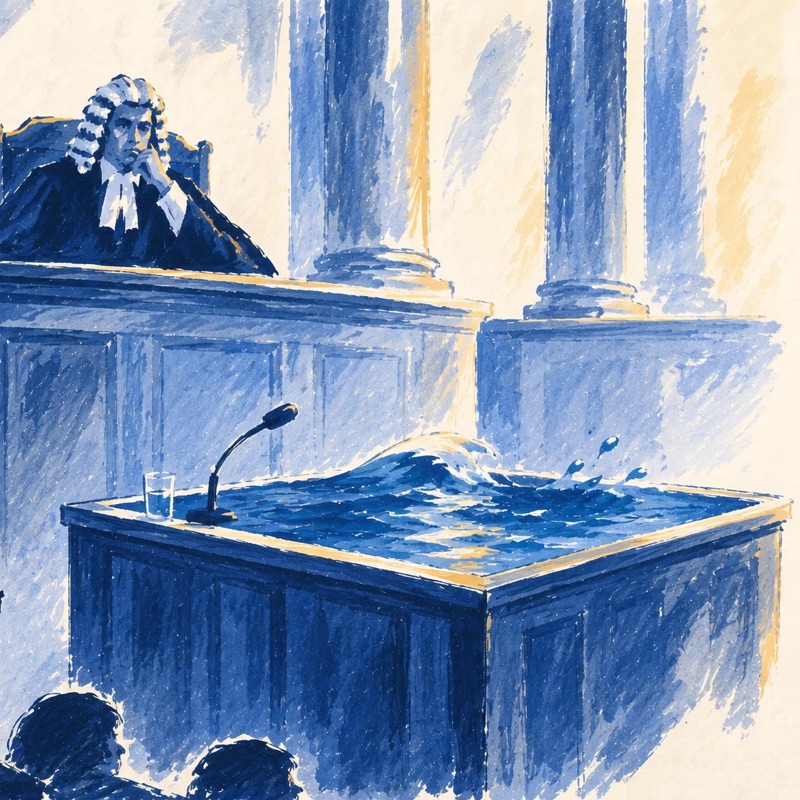
The Mar Menor is a person. Since September 2022, Europe’s largest saltwater lagoon, on the coast of Murcia in south-east Spain, has held rights under Spanish law: to exist, to evolve naturally, and to be protected and restored. It has guardians who can bring cases in its name. It has even asked the Swiss authorities for access to official documents.
For decades, fertiliser-rich water ran into the lagoon through the Albujón watercourse, on top of almost a century of copper and zinc from the mines around Cartagena, a Roman legacy stretching back millennia. In 2019, dead fish washed up along its shore by the tonne. Half a million people signed a petition, and Spain’s parliament made the Mar Menor the first ecosystem in Europe with legal personality.
The law protects people and their property far more readily than it protects nature, so rather than walking the long road towards greater legal consideration for the environment, Spain simply placed the lagoon in the category of persons. It was a simple practical shortcut.
But a lawyer’s workaround leaves a philosopher’s question: can a lagoon really be the kind of thing that is owed anything? One answer comes from an unexpected place: panpsychism, revived in the late 20th century after the “hard problem of consciousness,” with consciousness defined as the “what it is like to be” a certain thing. David Chalmers challenged neuroscience as a field of study, claiming that a purely functional understanding of the brain would never and could never provide an account of consciousness.
Panpsychism, instead of thinking of the mind functionally, holds that consciousness is not a rare product of brains but a basic feature of all matter. If it is right, the Mar Menor’s personhood may be more than a legal fiction.
Most theories struggle to explain how, in a universe of non-conscious matter, some matter, when arranged in a particular order, can somehow generate consciousness. The panpsychist offers an interesting solution: there is still only physical matter in the universe, but all of this matter is conscious. For the panpsychist, consciousness is similar to gravity; it is a fundamental fact of the universe.
In the way that Einstein’s theory of relativity states that gravity (and therefore gravitational orbits) are caused by depressions in space-time by all entities, most noticeably in larger entities, consciousness is alike. More complexly arranged systems possess a more complex level of consciousness. Consciousness is just the experience of being conscious matter. You can understand matter as something of an external shell, with consciousness as what lies within.
With complexity of organisation being the measure for consciousness, panpsychism leads to some intuitive solutions to questions of environmental ethics, meaning that at least pragmatically we may see a shift towards this sort of outlook towards ecosystems, treating them as persons in order to protect nature against humanity’s ever-growing demands.